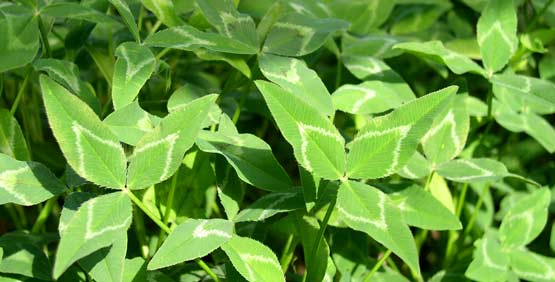
Management and recommendations:
- Test soil and follow lime and fertilizer recommendations
- Soil pH should be 6.0 to 6.5
- Plan acreage needed (0.5 to 0.8 acre/cow+calf)
- Graze or hay warm-season grasses to about two inch height before planting
- Disturb sod with light disking and plant 10 lbs/acre
- Arrowleaf clover will provide grazing from March to June
- Will also provide about 100 lb nitrogen/acre that will be available to
warm-season grasses through nutrient cycling - Not a reseeding system if grazed until June
New Arrowleaf Clover Cultivars with Improved Performance from the Forage Legume Breeding Program at Overton:
- Apache Arrowleaf Clover is tolerant to bean yellow mosaic virus disease. Apache was released by the Texas Agricultural Equipment Station (now Texas A&M AgriLife Research) in 2001. Apache arroleaf clover is licensed to East Texas Seed (903.597.6637). Please click on Apache Arrowleaf Clover for more information. (PVP #200200203)
- Blackhawk Arrowleaf Clover has multiple disease tolerance (both bean yellow mosaic virus and Pythium ultimum). Blackhawk was released by Texas A&M AgriLife Research in 2012. Blackhawk arrowleaf clover is licensed to Oregro Seeds (541.258.1001). Please click on Blackhawk Arrowleaf Clover for more information. (PVP pending)